


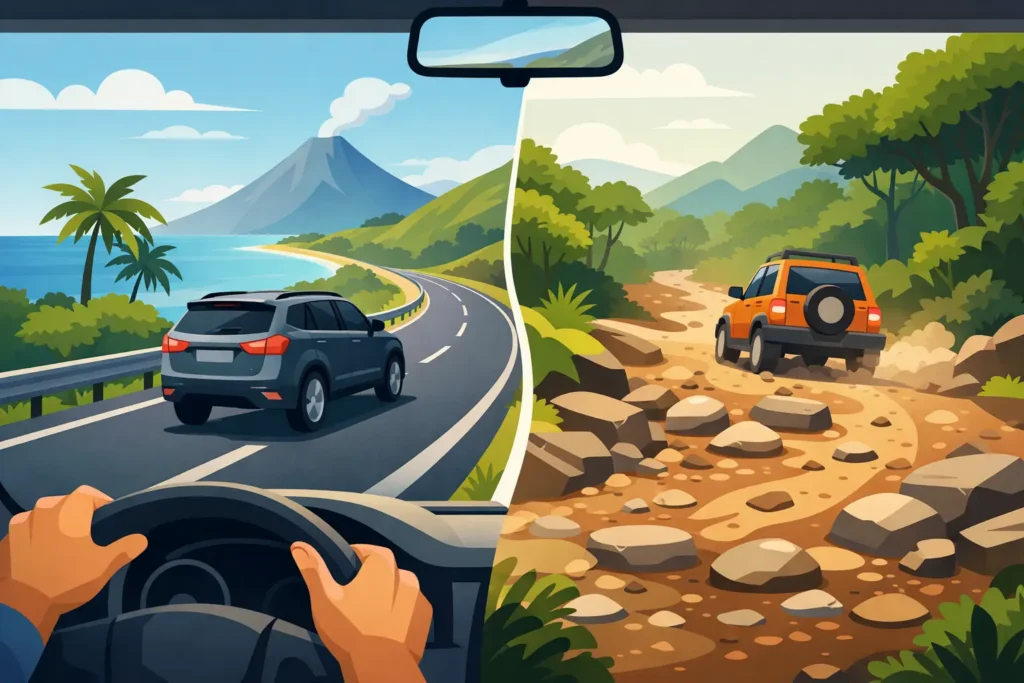
Your beach hotel may be only 45 miles from the airport, but that does not always mean a quick, easy drive. So, are Costa Rica roads paved? Many of the country’s main routes are paved and perfectly manageable, especially between airports, major cities, and leading vacation destinations. But pavement is only one part of the driving equation. Road width, mountain curves, weather, traffic, construction, and the final stretch to a villa or remote beach can change the experience quickly.
For travelers who want every vacation hour to feel effortless, the right answer is not simply whether a road is paved. It is whether the route, vehicle, and driving conditions fit your itinerary.
Are Costa Rica Roads Paved? The Short Answer
Yes. Costa Rica has a well-developed network of paved highways and regional roads connecting San José, Liberia, Tamarindo, Flamingo, La Fortuna, Manuel Antonio, Jacó, and many other high-demand destinations. If you are flying into Liberia and heading to the beaches of Guanacaste, much of your journey will typically be on paved roads.
Still, visitors should not expect every route to resemble an interstate highway in the United States or Canada. Some paved roads are narrow, winding, uneven, or shared with bicycles, motorcycles, farm traffic, pedestrians, and the occasional animal crossing. In rural areas, a paved route may transition to gravel, dirt, potholes, or a steep driveway near your accommodation.
That is normal in Costa Rica. It is also why local route knowledge matters.
Where You Can Expect Paved Roads
The country’s most traveled tourism corridors generally have paved access. Route 1, known as the Inter-American Highway, connects San José with Liberia and continues toward the Nicaraguan border. Route 21 and Route 160 serve key parts of Guanacaste, while other paved roads connect beach towns, national parks, volcano regions, and major lodging areas.
Travelers heading from Liberia Airport to Tamarindo, Playa Flamingo, Playa Conchal, Coco, or Papagayo will usually spend the majority of their transfer on paved roads. The quality can vary by section, but these are established visitor routes with consistent daily traffic.
The same is true for many popular routes from San José. You can reach destinations such as La Fortuna, Monteverde, Manuel Antonio, and Jacó via paved roads, although mountain terrain, congestion, and changing weather can make travel times longer than mileage suggests.
A paved road does not always mean a fast road. A 90-mile drive through rolling countryside or mountain passes can take three or four hours. That is part of Costa Rica’s geography, not a sign that anything has gone wrong.
Beach towns and resort areas
Guanacaste is among the easiest regions for first-time visitors to navigate because Liberia Airport offers convenient access to many beach destinations. Main roads leading toward Tamarindo and Flamingo are paved, and resort zones are accustomed to regular visitor traffic.
However, the final approach can be a different story. Boutique hotels, gated communities, surf breaks, hillside rentals, and secluded villas are often positioned away from the main road for privacy and ocean views. The last mile may be unpaved or rough, particularly during the green season.
Before renting a car, ask your host about the exact driveway and parking conditions. “Accessible by car” does not necessarily mean appropriate for every sedan.
Mountain, rainforest, and remote routes
Costa Rica’s most spectacular places are not always reached by the smoothest roads. Monteverde, certain parts of the Nicoya Peninsula, remote beaches, and rural lodges can require gravel-road driving. In some locations, a high-clearance SUV is more than a luxury. It is the sensible choice.
River crossings can also affect remote routes during heavy rain. While many commonly used roads have bridges, travelers should never assume an unfamiliar shortcut is safe after a storm. A navigation app may identify the shortest route without accounting for current road conditions, steep grades, or seasonal crossings.
What Paved Roads Are Actually Like
Costa Rican pavement varies widely. One section can be newly resurfaced and comfortable, while another has patched areas, potholes, sharp curves, or limited shoulders. Road signs may be less frequent than visitors expect, and lanes can feel narrow when large trucks or buses are approaching.
Driving after dark adds another layer of difficulty. Street lighting is limited outside populated areas, rain can reduce visibility, and cyclists or pedestrians may be harder to see. Even experienced drivers are better off arriving at a new destination during daylight whenever possible.
The green season, generally from May through November, requires extra flexibility. Afternoon rainstorms can be intense. Water may collect in low spots, loose gravel can shift, and unpaved access roads can become muddy. This does not mean you should avoid traveling during this beautiful, lush season. It means you should build extra time into the day and choose transportation that matches the route.
Should You Rent a Car or Book a Transfer?
A rental car gives you independence. It can be an excellent option for travelers who plan to explore multiple beaches, visit restaurants outside their resort area, or travel at their own pace. For paved routes between major destinations, a standard vehicle may be enough, provided your lodging is easy to access and you are comfortable driving internationally.
A 4×4 or high-clearance SUV is worth considering if your itinerary includes remote beaches, mountain lodges, rural roads, or properties with steep unpaved driveways. It also offers greater confidence during the rainy months. The trade-off is higher cost, more fuel use, and the responsibility of navigating unfamiliar roads.
Private transportation is often the stronger choice for families, groups, couples celebrating a special trip, or visitors arriving after a long flight. You do not need to locate your rental counter, decode road signs, manage luggage in a compact vehicle, or worry about reaching a hillside villa after sunset. A professional driver handles the route while you settle in, enjoy the scenery, and start your vacation without the stress.
For airport pickups, regional transfers, and multi-stop itineraries, 506 Transfers provides the local coordination that turns road uncertainty into a smooth arrival. It is especially valuable when your destination is outside the main tourism corridor or when you want a driver who already knows the best approach to your hotel.
Smart Driving Expectations for First-Time Visitors
If you choose to drive, plan around time rather than distance. Add a cushion for traffic near San José, slower-moving vehicles on two-lane roads, photo stops, construction, and weather. Avoid scheduling a tight dinner reservation immediately after a cross-country drive.
Download maps before leaving areas with reliable service, keep your fuel level comfortably above empty, and follow the route recommended by your hotel or local transportation provider. If a road looks questionable after heavy rain, turn around rather than forcing a crossing or following an unfamiliar detour.
It also helps to keep your itinerary realistic. A week in Guanacaste can be relaxed and rewarding without attempting to drive to Arenal, Monteverde, Manuel Antonio, and back between beach days. Costa Rica is compact on a map, but its terrain rewards travelers who slow down.
The Best Way to Plan Around Road Conditions
Start with your arrival airport and lodging address, then look beyond the broad destination name. “Tamarindo” may mean a hotel in town with straightforward paved access, or it may mean a villa outside town on a steep road. “La Fortuna” could place you close to the center or far along a rural road near the volcano.
Ask three practical questions before choosing your transportation: Is the final access road paved? Will you arrive before dark? Does the property recommend a 4×4? Those answers will tell you far more than a general statement about Costa Rica’s roads.
Costa Rica is best experienced with room for the unexpected – a waterfall viewpoint, a troop of monkeys by the roadside, a beach sunset that makes you stay longer than planned. Choose a vehicle or driver that lets you enjoy those moments with confidence, and the road becomes part of the vacation rather than an obstacle to it.